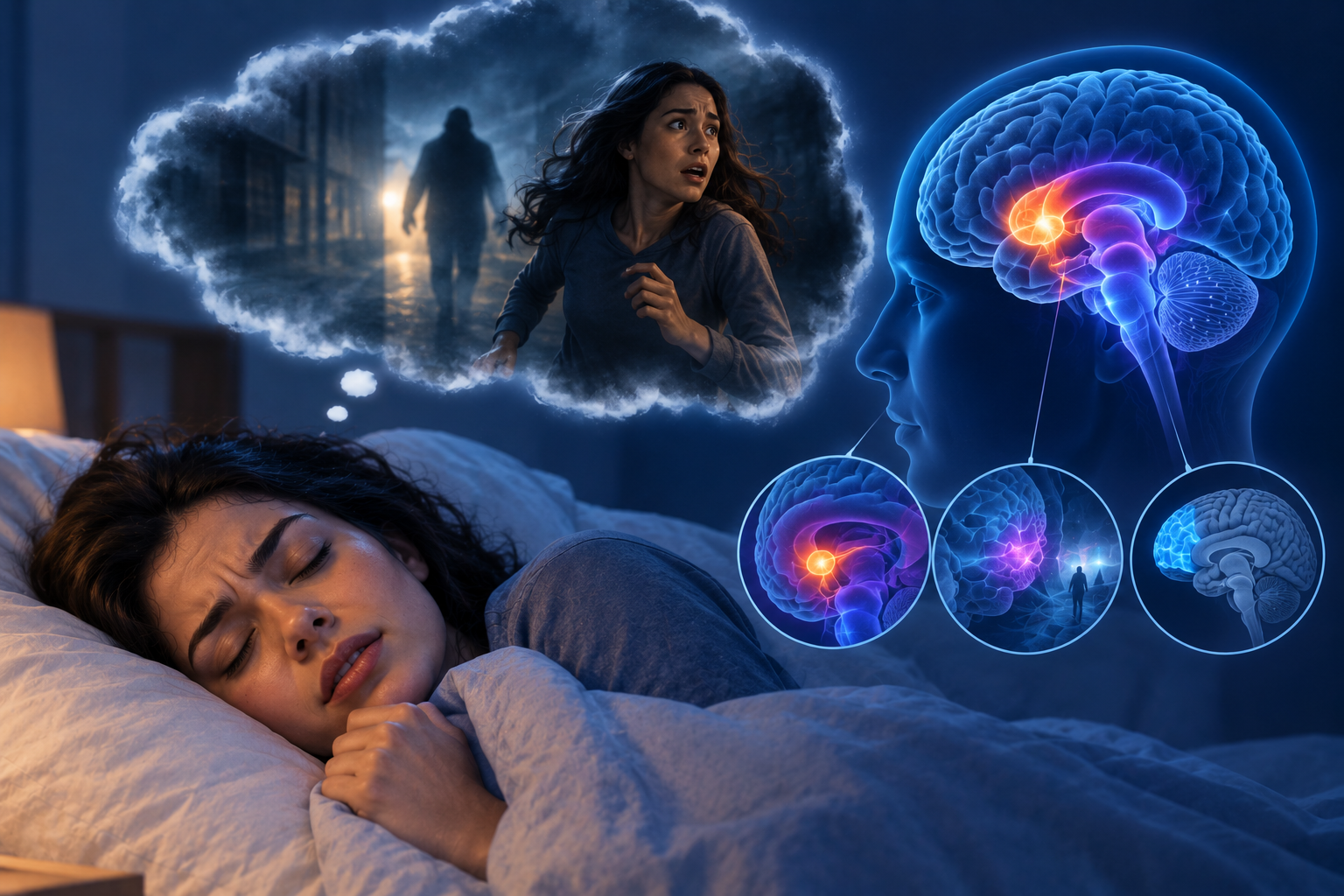
What Happens in Your Brain During a Nightmare?
Have you ever woken up suddenly after a frightening dream, with your heart racing and the feeling that something terrible had just happened? Nightmares can feel surprisingly real because your brain is still highly active while you sleep. Even though your body is resting, different brain regions continue to process emotions, memories, images, and sensations.
Nightmares are especially common during REM (rapid eye movement) sleep, the stage in which vivid dreams often occur. During this time, the brain can create intense emotional experiences even though there is no real danger around you.
What Is a Nightmare?
A nightmare is a frightening or unpleasant dream that can cause strong emotions such as fear, anxiety, sadness, anger, guilt, or embarrassment. You may wake up remembering parts of the dream very clearly.
Like ordinary dreams, nightmares are created through activity in several connected areas of the brain. The brain combines memories, emotions, thoughts, and imagined situations to create a dream experience. This is why a nightmare can place you in a situation that feels completely real even though you are safely asleep.
What Happens in Your Brain During a Nightmare?
Emotional Brain Regions
During a frightening dream, areas involved in processing emotions become highly active. One important region is the amygdala, which helps the brain detect and respond to possible threats.
This can help explain why fear can feel so powerful during a nightmare. You might dream that someone is chasing you, that you are trapped somewhere, or that a loved one is in danger. Even though nothing is actually happening, your brain can produce a strong emotional response.
The hippocampus, which plays an important role in memory, can also contribute by bringing pieces of past experiences into the dream. These memories may be mixed with imagined situations to create a frightening story.
Sensory Brain Regions
Your brain can also activate areas involved in creating images and other sensory experiences during dreams. This allows you to see places, people, objects, and movements even though your eyes are closed.
For example, during a nightmare, you may clearly see a dark room, hear footsteps behind you, or feel as though you are falling. The experience feels real because your brain is creating these sensations internally rather than receiving them directly from the outside world.
Changes During REM Sleep
During REM sleep, the brain remains very active, but it does not work exactly as it does when you are awake. Brain regions involved in emotions and imagery can be highly active, while some areas involved in logical thinking and reality-checking work differently.
This may explain why a person can accept something completely impossible in a nightmare without questioning it. You might be running from a monster, falling from the sky, or suddenly finding yourself in an unfamiliar place, yet the dream feels believable while it is happening.
Why Do Nightmares Feel So Real?
Nightmares can feel real because the brain is actively creating emotional and sensory experiences. The images, sounds, memories, and emotions in the dream can become very vivid.
For example, if you dream that you are being chased, your brain may create the image of the person following you, the sound of footsteps, the feeling of running, and the fear that something bad is about to happen. Your body may even respond with a faster heartbeat or increased alertness after you wake up.
The dream feels real because the brain is producing a complete experience, even though the danger itself is not real.
What Role Does the Amygdala Play in Nightmares?
The amygdala is closely involved in processing fear and other emotional responses. During dreaming, activity in emotional brain networks can contribute to the strong feelings experienced in nightmares.
This is why a nightmare can trigger intense fear even when you are lying safely in bed. The brain does not need a real threat to create a frightening experience during a dream.
The amygdala also works with other brain regions involved in memory and emotion. Together, these systems can bring emotional memories into a dream and combine them with imagined situations.
For more information about how the amygdala behaves during dreaming, you can read our related article on the amygdala and dreaming.
Why Do Stressful Experiences Sometimes Appear in Nightmares?
Nightmares are not always random. Experiences and emotions from your life can sometimes become part of your dreams.
If you have been worried about an exam, having problems at work, arguing with someone, or going through a stressful period, those emotions may appear in your dreams in a different form.
For example, stress about an important deadline might become a dream in which you are running late and cannot reach your destination. Anxiety about a relationship might appear as a dream about losing someone. The dream does not necessarily copy the real event, instead, the brain may turn the emotion into a completely different story.
During sleep, the brain continues to process emotional experiences and memories. This may be one reason stressful emotions can sometimes appear in nightmares.
Are All Bad Dreams Nightmares?
Not every unpleasant dream is necessarily a nightmare.
A bad or uncomfortable dream may make you feel uneasy, but a nightmare is generally more intense and can cause strong fear or distress. Nightmares are also more likely to wake you up, leaving you with a clear memory of what happened.
For example, dreaming that you missed a bus may be unpleasant, while dreaming that you are trapped somewhere and cannot escape may produce much stronger fear and cause you to wake suddenly.
The experience can vary from person to person, so there is no single level of fear that separates every bad dream from a nightmare.
Nightmares vs Sleep Terrors
Nightmares and sleep terrors are not the same thing.
During a nightmare, a person usually wakes up and can often remember at least part of the frightening dream. Sleep terrors are different. A person may suddenly sit up, scream, appear frightened, or move around while still partly asleep, and they may have little or no memory of the event afterward.
Sleep terrors are more common during NREM sleep, while nightmares commonly occur during REM sleep. This difference helps explain why the two experiences can look very different.
When Do Frequent Nightmares Become a Problem?
Having an occasional nightmare is normal. However, frequent nightmares can become a problem when they repeatedly disturb your sleep or affect how you feel during the day.
For example, someone who regularly wakes from frightening dreams may become worried about going to sleep, feel tired during the day, or have difficulty concentrating.
Frequent nightmares can sometimes occur during periods of stress, after disturbing experiences, or alongside certain sleep problems. If nightmares happen regularly and seriously interfere with sleep or daily life, discussing them with a qualified healthcare professional can be helpful.