What Makes the Brain: Structures & Functions
Brain.mp4Brief introduction to the human brain: major parts, roles, and how it processes information.
When I was very younger, I mistakenly thought that the brain is just a little part of the human body. But as I grew older, I realized that the brain is the single organ on which the entire body depends; without it, your body cannot function.
Let's discuss a few brain functions, what the brain actually does, and why the human body needs it.
I assure that after reading this blog, you will have a fundamental understanding of the brain.
What is the Brain??
The human brain is unique; it is where information is processed and managed in human body. It is about 3 pounds (1.4 kg), which is not particularly impressive when it comes to organs. It doesn't expand and contract like the lungs, pump like the heart, or release visible substances like the bladder.
The brain is the most complex part in the body and most likely the most complex system in human history. It is made up of billions of neurons that constantly sending signals to each other. So, that's why it is known as "central organ of the nervous system ", It is the center of a huge and complicated communications network that continuously searches for and gathers information from the rest of the body and the outside world, keeps us prepared to respond to the world around us.
It's responsible for movement, sensation, emotion, thinking, and bodily function regulation.
That I think you all have a better understanding of what the human brain is right?
Let's discuss the various components of the human brain, or more accurately, its structure.
Why it's crucial to talk about the various areas of the human brain because every part performs a different function.
Parts of the Human Brain and its functions
The human brain is composed of approximately 75% to 80% water it means over 3/4 part of the brain is filled with water. So, maintaining proper hydration is essential for brain health and cognitive function.
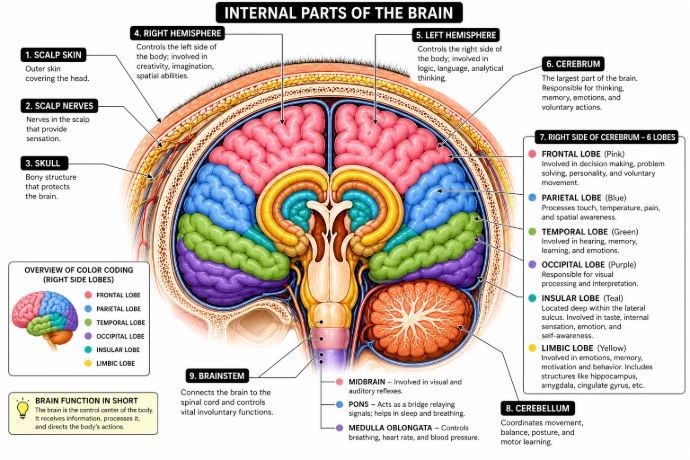
Here we start with.
SCALP SKIN
The scalp acts as a barrier to shield the brain from external forces. Additionally, it is a part of the immune system that aids in defending the brain from dangerous bacteria and diseases.
SCALP NERVES
The scalp nerves are an important part of the brain's sensory system. They are in responsible for sending physical sensations from the skin to the brain, including touch, pain, and temperature.
SKULL
The skull is crucial because it protects the brain from injury and other harm.
We will now discuss the major components of the brain, which are the cerebellum, cerebrum and the brainstem each of which perform a different function.
CEREBELLUM
The lower, backmost portion of the brain is referred to as the "little brain."
The primary roles of the cerebellum are to coordinate movements of the body through integrated regulation of muscles, including speech, balance, and posture.
CEREBRUM
The human brain is completely dominated by the cerebrum, the large pinky-gray wrinkled structure that forms more than three-quarters of the brain’s total volume. The cerebrum is divided into left and right hemispheres
It’s responsible for higher brain functions, including thought, action, emotion, and interpretation of sensory data.
LEFT HEMISPHERE
The left side of the brain often referred to as the "logical" side of the brain controls the right-hand side of the body.
It regulates speech, language, word, letter, and number recognition, reading, writing, mathematical reasoning, sequential problem solving, and plays a key role in analytical thinking, grammar, and syntax.
RIGHT HEMISPHERE
The right hemisphere is referred to as the "intuitive" side. It receives information from the left visual field and regulates the left side of the body.
It is more involved in music and creative abilities and regulates creativity, awareness, context, and recognition of faces, places, and objects. It also understands emotions and visualizes patterns.
CEREBRUM LOBES
The six lobes that make up the cerebral cortex are the frontal, parietal, temporal, occipital, insular, and limbic lobes. The cerebrum's lobes each have distinctive surface characteristics that serve different purposes.
FRONTAL LOBE
The largest lobe in the brain, making up over one-third of the hemispheric surface, is the frontal lobe. Its functions include decision-making, problem-solving, consciousness, emotions, and the control of intentional behaviors.
PARIETAL LOBE
The parietal lobe is located behind the frontal lobe. It is involved in the processing of touch, temperature, and pain, among other sensory data. Additionally, it controls sense of balance.
TEMPORAL LOBE
The lateral sulcus, also known as the Sylvian fissure, divides the temporal lobe superiorly from the frontal and parietal lobes. focuses mostly on auditory perception and is crucial for processing speech, vision (reading), hearing, and sensory aspects of memory.
OCCIPITAL LOBE
The occipital lobe, located at the back of the brain, serves as the primary visual processing region.
INSULAR LOBE
The brain's fifth lobe is called the insular lobe. Although this lobe is not readily seen from the outside, it can be seen when the temporal lobe is pulled back from the brain. Taste senses visceral, senses, sense of pain, and vestibular function are among the many forms of information that are processed and integrated by the insula.
LIMBIC LOBE
The limbic lobe is located just deep to the frontal, parietal, and temporal lobes and covers the edge of the brain's ventricles. Emotional regulation, autonomic, visceral, hormonal, learning, memory, and behavior are all regulated by it.
BRAINSTEM
Your brain and spinal cord are connected via the brainstem. It is located close to the base of the brain.
It helps control essential bodily processes like breathing and heart rate that you don't have to think about. Additionally, your brainstem supports your reflexes, balance, blood pressure and coordination.
brainstem is a component of your central nervous system and is composed of three interconnected elements midbrain, pons and medulla oblongata.
MIDBRAIN
Midbrain is the upper portion of your brainstem. The midbrain plays a number of roles, including processing of vision and hearing as well as motor control, especially with related to eye movements.
PONS
Pons is the center part of your brainstem, which controls hearing, balance, facial sensations, and eye and face movements, sleep and breathing.
MEDULLA OBLONGATA
Medulla oblongata is the lower portion of the brainstem that controls blood pressure, respiration, heart rate, and swallowing
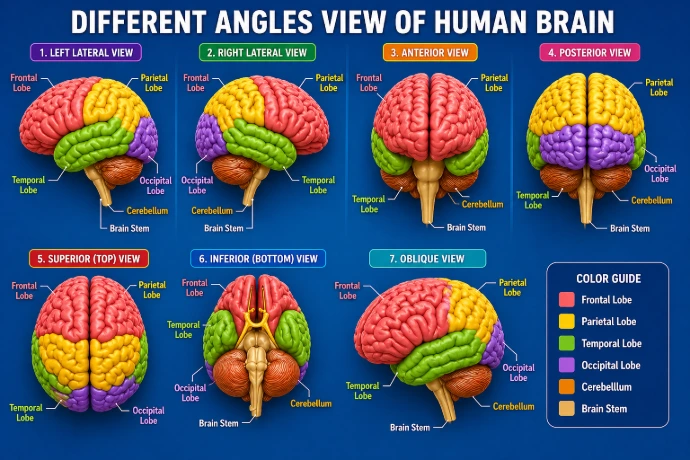
The BRAIN with different angle
Let's see a image of the various angles of the brain to make it more interesting.