What Is the Amygdala?
The human amygdala is a small, almond shaped structure located deep within the medial temporal lobes, that acts as an emotional alarm system like a threat detector.
It is a subcortical structure which means its acts on instinct and not reasoning, reasoning happens in cortex. Additionally, the amygdala plays a role in several areas of sleep regulation.
For a detailed understanding of the amygdala and its role in emotional processing, you can read our previous blog, Brain Emotions & How We React in Situations.
What Happens to the Amygdala During Dreaming?
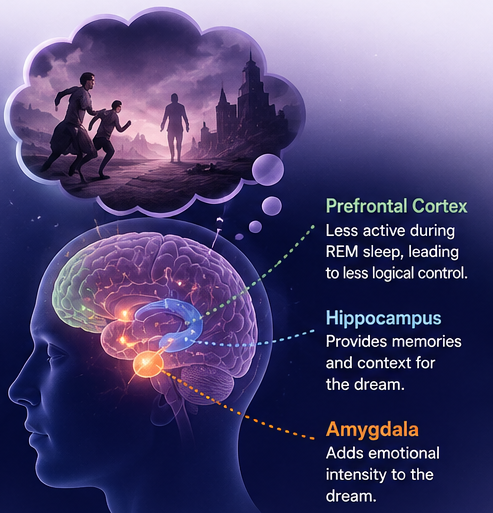
Dream vividness, bizarreness, and emotional intensity are all influenced by the amygdala, which is a key role in the emotional and subjective aspects of dreaming.
Is the Amygdala Active During REM Sleep?
Yes, research suggests that the amygdala remains highly active during REM sleep and may play an important role in processing emotional memories. REM sleep is a stage in which the brain becomes active in ways that are similar to wakefulness, particularly in areas involved in emotions and memory.
The amygdala is responsible for processing emotionally important experiences, especially those involving fear, stress, and danger. During REM sleep, neural networks involving the amygdala may become reactivated. This reactivation may allow the brain to process emotional experiences that were stored during wakefulness.
One proposed explanation is called the “sleep to remember, sleep to forget” hypothesis. According to this idea, REM sleep may help the brain preserve important information from an emotional experience while reducing the intensity of the emotional response connected to it. For example, a stressful event may remain in memory, but the strong fear or anxiety associated with that event may gradually become weaker.
During wakefulness, the amygdala works together with the hippocampus to encode and strengthen emotional memories. During later REM sleep, these brain networks may be reactivated, allowing the emotional aspects of those memories to be processed again.
REM sleep also occurs in a different chemical environment from wakefulness, with lower levels of some stress-related neuromodulators. This may provide the brain with an opportunity to process emotional memories without producing the same level of emotional arousal experienced during the original event.
Therefore, amygdala activity during REM sleep may help the brain process, regulate, and possibly reduce the emotional intensity of memories. However, the exact role of the amygdala during REM sleep is still being investigated.
How Does the Amygdala Interact With Other Brain Regions?
The amygdala does not work alone. It communicates with several other brain regions to process emotions, memories, and responses to different situations. Two of its important connections are with the hippocampus and the prefrontal cortex.
Amygdala and Hippocampus
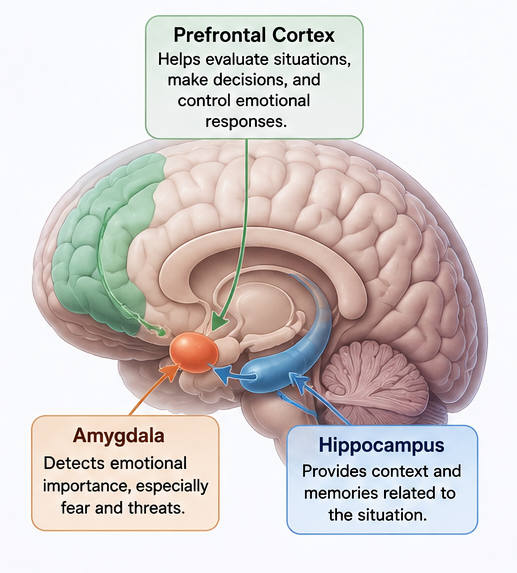
The amygdala and hippocampus work closely together to connect emotions with memories. The hippocampus provides information about the situation or event, while the amygdala helps determine its emotional importance.
For example, if you previously experienced a frightening event in a particular place, the hippocampus can help you remember where and when it happened. At the same time, the amygdala can bring back the fear or anxiety associated with that memory. This interaction helps the brain recognize situations that may be important or potentially dangerous.
The communication between these two regions is also important during emotional memory processing. The amygdala can strengthen memories of emotionally significant events, while the hippocampus helps provide the context surrounding those memories.
Amygdala and Prefrontal Cortex
The amygdala also communicates with the prefrontal cortex, which helps us evaluate situations, make decisions, and control emotional responses.
When the amygdala detects something threatening, it can produce a rapid emotional response. The prefrontal cortex can then evaluate whether the situation is actually dangerous and help regulate the response. This allows us to think about the situation before deciding how to react.
For example, if someone suddenly moves toward you, the amygdala may quickly interpret the movement as a possible threat. The prefrontal cortex can then assess the situation and determine whether there is a real danger. In this way, communication between the amygdala and prefrontal cortex helps balance emotional reactions with logical thinking.
Together, these connections allow the amygdala to work as part of a larger brain network involved in emotion, memory, decision-making, and behavioral responses.
Does the Amygdala Cause Dreams?
The amygdala does not directly cause dreams. Instead, it is one of several brain regions that contribute to the emotional experiences we have during dreams. It is particularly involved in processing emotions such as fear, anxiety, excitement, and other strong feelings.
During REM sleep, when vivid dreaming commonly occurs, activity in brain regions involved in emotion can increase. The amygdala may become active during this time and interact with other brain regions involved in memory, perception, and emotion. This activity may help explain why dreams can sometimes feel emotionally intense or realistic.
The amygdala may also influence the emotional tone of a dream. For example, if the amygdala is involved in processing fear during REM sleep, a dream may contain threatening situations, such as being chased, falling, or being in danger. However, this does not mean that the amygdala creates the entire dream. Other brain regions contribute to the images, memories, thoughts, and story-like experiences that make up a dream.
The hippocampus may contribute memories and contextual information, while areas of the prefrontal cortex involved in logical thinking and self-control show different patterns of activity during REM sleep. The interaction between these regions can contribute to the unusual and sometimes emotional nature of dreams.
Therefore, the amygdala is not the sole cause of dreams. Instead, it appears to play an important role in the emotional aspects of dreaming, particularly during REM sleep.